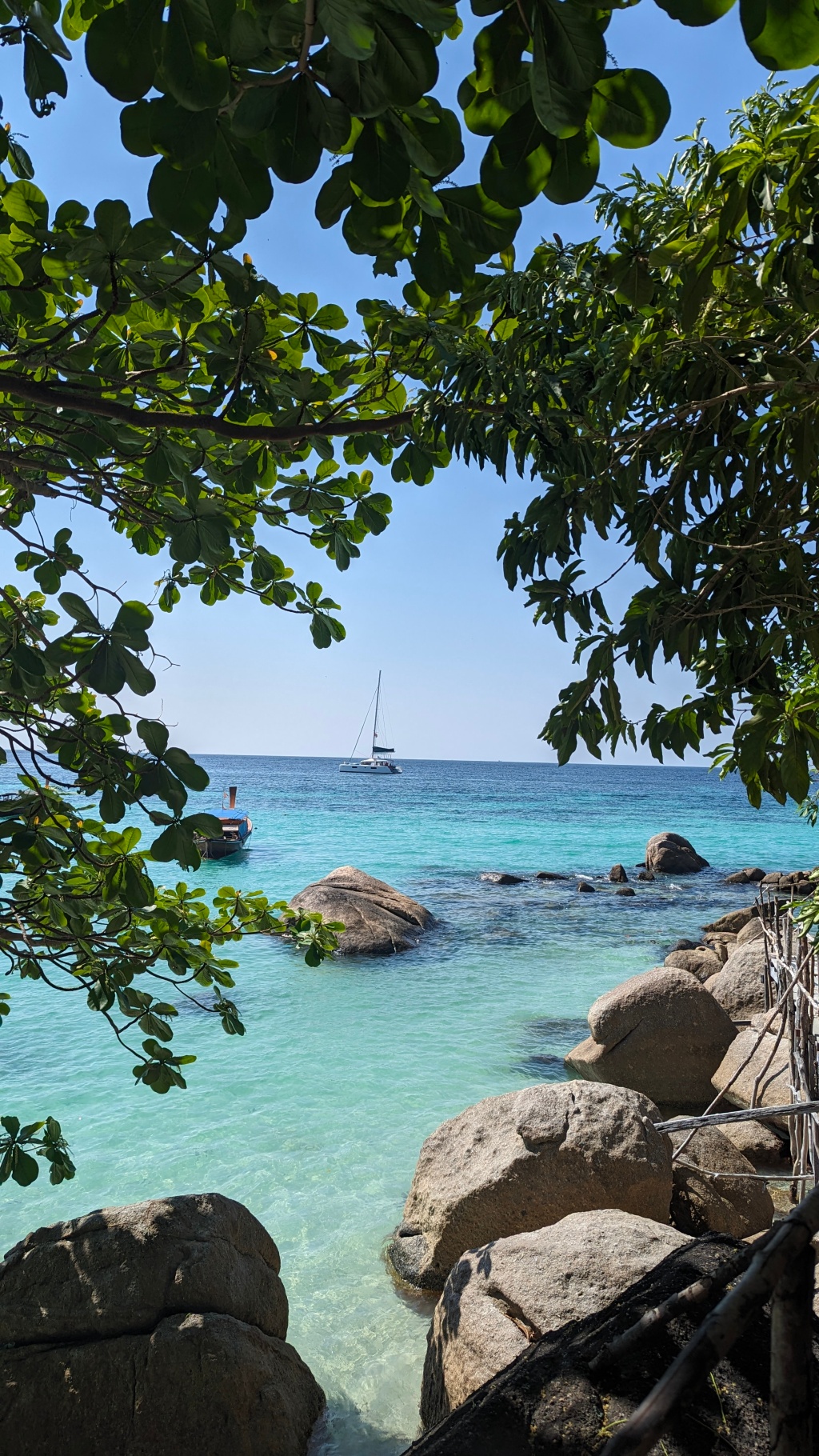
Koh Lipe is a beautiful Thai island, closer to Malaysia than mainland Thailand. It’s referred to as the Maldives of Thailand and it’s easy to see why. The white sandy beaches, beautiful blue water, hidden beaches and stunning sunsets make this island a perfect getaway.
Koh Lipe is more expensive than mainland Thailand and a few other Thai islands. It’s not pricey at all compared with the UK, Europe or the US of course, but if you’re on a backpacking budget you’ll notice the prices are somewhat higher than most of South East Asia. Additionally, there are plenty of restaurants on Koh Lipe serving Western or Indian food, and not many just serving local Thai food.
In light of all of this we set out to find the best local restaurants serving delicious Thai food on Koh Lipe without breaking the bank, and have shared that list below!
We’ve given the price of a Pad Thai as a benchmark dish, but prices for various dishes do of course differ from place to place.
Seven of the best local restaurants on Koh Lipe
Beaches of Koh Lipe
The best seafood
Despite the name, we actually couldn’t see any fresh seafood on offer so we decided not to order any of that, perhaps because we ate at lunch time… Regardless the food is decent and the portions are huge. The shining star of their menu are the smoothies – the best we had on the island and we went back to get another the next day!
There was a proper locals vibe at Tasneem’s both times we ate there. The people working at the restaurant are really friendly and attentive without being pushy and the food is great as well. We can definitely recommend the mango salad which was a delicious!
Pad Thai: 70-90฿ depending on whether you have veg only or add proteins
Thaidurm Restaurant
We found this place by accident and ended up going back twice, the seafood was delicious as was the Pad Thai and actually not as pricey for fish as other places we saw so if you want to try some on the island, here is a great option.
Just a word of warning – don’t be fooled by the juice stand across the road, they look amazing but if you get large one they’re super watered down which is disappointing.
This is a huge restaurant but it’s super busy here every night! The food is really tasty with generous portions and the service is quick and friendly despite them being so busy. There’s a lot of seafood on offer here which makes the prices a bit higher than other places on this list but the prawns we had in our Massaman curry were gigantic and delicious!
Serene restaurant is right on Walking Street which makes it very central on the island. We had lunch here twice as the food was very tasty and quick. The menu is well priced given its location and the one woman who does all the cooking here cooks in a classic open kitchen meaning you can see your food being made.
Despite a name that seemingly was entered into Google maps without any spaces, this place deserves a visit! It’s a bit rough around the edges but the staff and food are nice enough. The restaurant is fairly small but the service is very quick and the papaya salad has just the right amount of spice and lime – delicious!
This little local restaurant should absolutely be on your must eat list in Koh Lipe. We went back twice and loved every single mouthful. It’s basically a phò place and is amazingly cheap. There’s no menu, you just go to the counter and choose the meat you’d like (chicken or pork or a mix) and your noodles (thick or thin). For those of you who have visited Vietnam, it will bring back a flood of memories! It’s run by a really sweet couple, highly recommended!
Pad Thai: No Pad Thai here, but each dish costs between 60-80฿ depending on whether you choose a single type of meat or a mix!
There we have it! Seven local restaurants on Koh Lipe to eat delicious Thai food at, without breaking the bank. Let us know if you tried any of these – leave a comment below or find us on Instagram!
Thailand E-SIM Luang Prabang to Vang Vieng Luang Prabang to Vientiane
This post contains affiliate links for some sites that we use extensively on our travels and have decided to partner with. Did you know you can support us, at no additional cost to you, by clicking through and making a purchase using those links? Thank you in advance!
Arriving in Singapore is a shock to the senses, it’s like a cross between Avatar, some science-y futuristic lab, and In Time – you know that film with Cillian Murphy, Justin Timberlake and Amanda Seyfried where all the rich people just move about so beautifully in a clean, calm and quiet city.
Singapore is certainly rich and certainly expensive, especially if you’re coming to it from a backpacking trip around SE Asia. But there are plenty of ways to keep spending in Singapore down, and the budget intact. We visited for three days, saw loads, ate loads, stayed centrally, and it cost us £270 including accommodation and some fancy coffees (we just like coffee…this is optional!). The reason our spending didn’t soar into the thousands is because there is just so much to do that’s free in Singapore which is amazing, and helpful. Even better, the free activities don’t feel like you’re missing out, they’re genuinely cool. We’ll cover our full spend breakdown in another post but first, here is everything you can do for free in Singapore!
12 completely free things to do in Singapore
All of these places, activities, sights are actually free – no hidden costs here. Let’s get into them:
1. Gardens by the Bay
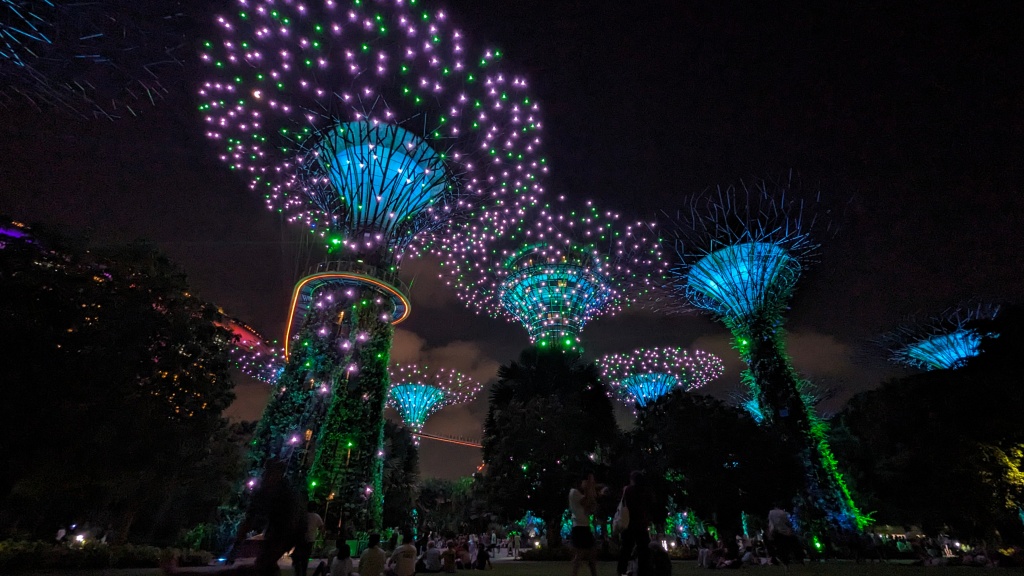
The Gardens by the Bay are a famous Singapore landmark primarily known for the stunning architectural trees covered in climbing plants and flowers. The gardens themselves are also beautiful and cover a large distance around the bay by themselves. The twice nightly light show set to music takes place in Garden Rhapsody and is free to watch. Join the crowds to sit beneath the trees and watch the shows play out. Happily you will always get a good view as the show happens at a height of 25-50 meters.
Timings: the light is on 7:45pm & 8:45pm every night; the gardens are open 24/7
2. Thian Hock Keng Temple
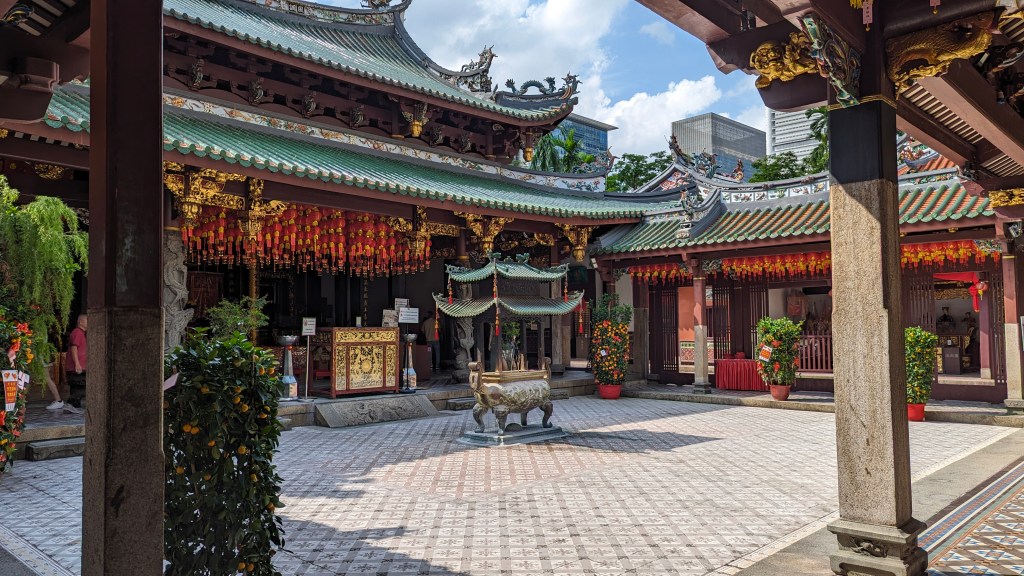
Located in a busy and popular part of Singapore’s Central Area is this small Taoist temple. Although the majority religion in Singapore is Buddhism, almost 10% of Singapore’s residents declared themselves as Taoist in the 2020 census.
Even though this temple is directly on the street it feels tucked away and secret. People rarely stay for long as it’s size doesn’t require a lot of time, and locals quietly slip in and out to pray and leave donations. It has amazing decorations, especially its doors, and is a quiet, peaceful space that deserves a visit.
Singapore is almost 47% green space which apparently makes it the greenest city in Asia! This is great for loads of reasons, biodiversity and climate protection being two key ones, but for tourists and locals it also means that there are things to do in Singapore which involve nature. This green stretch runs along the west and south of Singapore for 24kms and has a ton of access points to metro stations and pathways back into built up areas which makes joining this path easy. Cars and motorbikes aren’t allowed and cyclists are meant to stick to a 10kmp/h speed limit (not sure that’s adhered to!) but the point is to maintain this space as pleasant for everyone.
If you walk along the route it’s entirely free, if you’d rather cycle use ‘hellobike’ for the best rates and ease of use.
HelloBike is an app based bike rental, all you need to do is download the app, find a nearby bike, scan the QR code to unlock it then off you go. Keep an eye on the time/spend and find an accepted park up spot. The map on the app will show you your options and you’ll need to scan the QR code (usually on the floor) by the parking bay to end your rental. HelloBike also has sign up discounts so if you’re cycling in a pair or group you can gift free 30 minute cycle and reduce your overall cost! Without the freebie, a 1hr cycle is $2.50 (£1.50).
Timings: Open 24/7 but as the corridor is also used to provide animal crossings and protect wildlife the route isn’t lit with street lights when it gets dark – so take care if you’re walking or cycling at night.
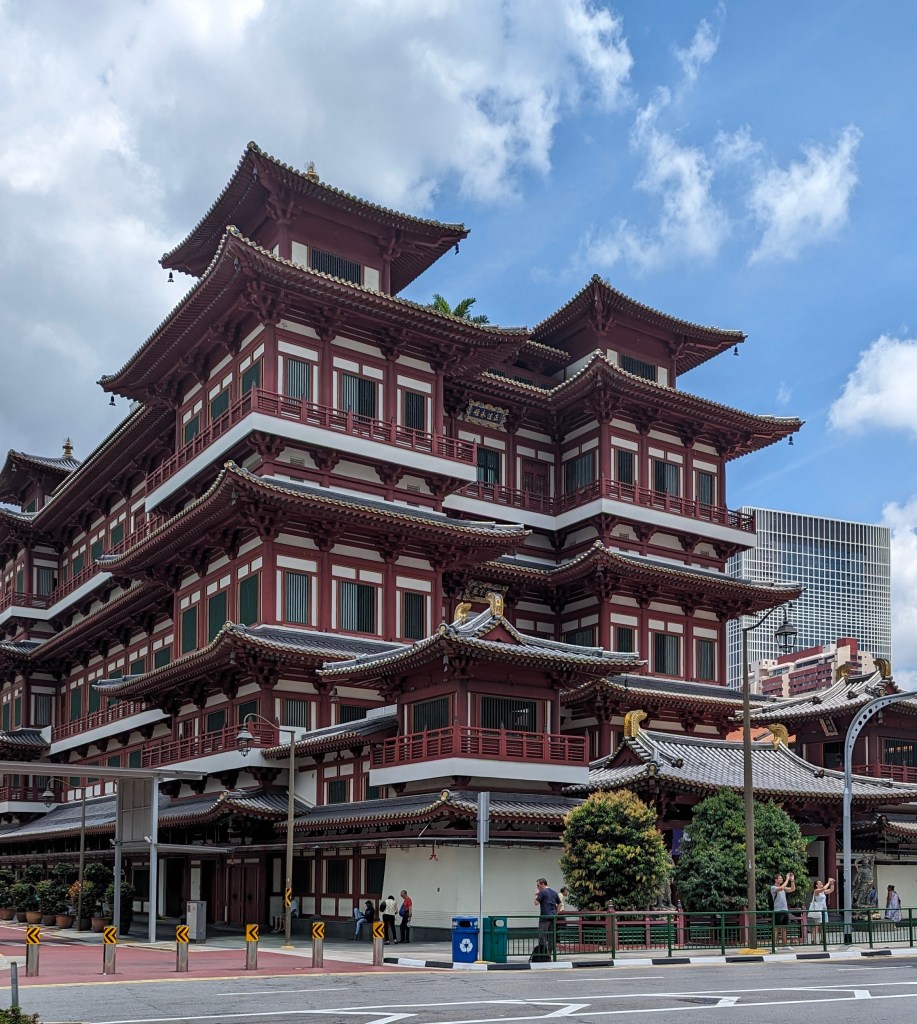
4. Buddha Tooth Relic Temple
This is an absolutely gigantic modern Buddhist temple covering four floors. It’s centrally located in Chinatown and has a lot going on!
The temple was only built in 2007 and is highly decorative, the amount of fundraising, planning, and local input into this space to make it the highly decorative and bustling temple it is, is impressive, if not a little overwhelming!
The temples houses two floors of museums. One covers relics and the Buddha Tooth Relic specifically and how the temple was built. The other floor discusses Buddhism and the Sangha, the Buddhist community. The top floor houses the relic itself inside a reliquary made of solid gold.
In addition to the museum there is a roof terrace and mezzanine level. Take your time to visit this place, it’s usually busy as it’s an active temple and there’s a lot to see and take in.
You need to dress respectfully here but there are sarongs on offer for free to borrow for your visit.
Just north of the Bukit Timah area of Singapore is a huge nature reserve full of jungle trees, walking trails, bird and monkeys.
One of the famous trails here is the Tree Top Walk, a 250m free hanging suspension walkway between the trees. This bridge forms part of a longer trail, so do be aware that you can’t just do the walkway and head back to the car (or whatever mode of transport you might be taking!). There are a couple of routes to get to the walkway but the most straightforward way is to take the MacRitchie Tree Top Walk trail which is 7kms loop and starts (and ends) from the Windsor Nature Carpark. This point is easily accessible via the metro and a short walk, or a bus that will drop you close to the car park.
The nature reserve gets very busy at the weekends as locals take to the area to hike and catch up with friends. There’s still plenty of room for all, but for a quieter walk try to go during the working week.
Timings: The nature reserve area is open 24/7 however the Tree Top walk bridge is open as follows: Tuesday – Friday 9:00am – 5:00pm, Saturday/Sunday 8:30am-5:00pm, Monday Closed.
6. Marina Bay light show
Singapore’s Marina Bay area is impressive! It’s the center of gigantic and fancy hotels, a humungous shopping mall and beautiful designer shops on the waterfront. There is also a large sweeping boardwalk right by the water and easy access to Gardens by the Bay. From Thursdays to Sundays, twice a night, there is a beautiful fountain light show, set to music. Singapore does these kinds of entertainments really well, and this is no exception.
The show lasts for 15 minutes each time and you’ll want to get a good spot as the crowds do come here and the view is onto the water. Google directions can be a little confusing on where to put yourself, so head for the Apple Store on Marina Bay and then find a spot between the Apple Store and Louis Vuitton for a great spot to watch the free show!
Singapore’s Little India is an amazing place – we loved exploring it and there was so much to see. Sri Veeramakaliamman Temple is small but beautiful and brightly decorated temple in Little India.
It’s an active spot so you’ll want to stand to the side to avoid getting in the way of people paying their respects and making offerings but visitors are welcome to observe. You will need to remove your shoes and store them on the shelves outside and cover up. There are free sarongs to borrow for your visit by the entrance.
Timings: 05:30am-12:00pm & 5:00pm – 9:00pm every day
8. Botanic Garden
The Botanic Garden in Singapore is situated in the Tanglin area of Singapore and provides a large and manicured space for people to come and relax, enjoy the greenery, or visit specific exhibitions.
As well as simply being a huge park to meet up with friends, picnic in, or just wander about for a couple of hours – the park runs monthly free tours (usually on Saturdays) facilitated by volunteers on different topics. You can find the latest calendar of events here.
The Botanic Garden also houses some free art exhibitions, check out the Botanical Art Gallery for their latest exhibitions. In fact, the only exhibit that charges a fee is the Orchid House in Singapore’s Botanic Garden, and while it is spectacular (it was the only thing we actually paid for during our stay in Singapore), it isn’t for everyone – making the Botanic Gardens another great free activity!
This colorful house of a former sweet shop owner, is the last surviving Chinese villa in Little India. It was built in the 1990s and while you can no longer go inside, the outside is stunning and should definitely form part of your wanderings around Little India.
Timings: No entry – available 24/7 for photos and admiration
10. Sultan Mosque
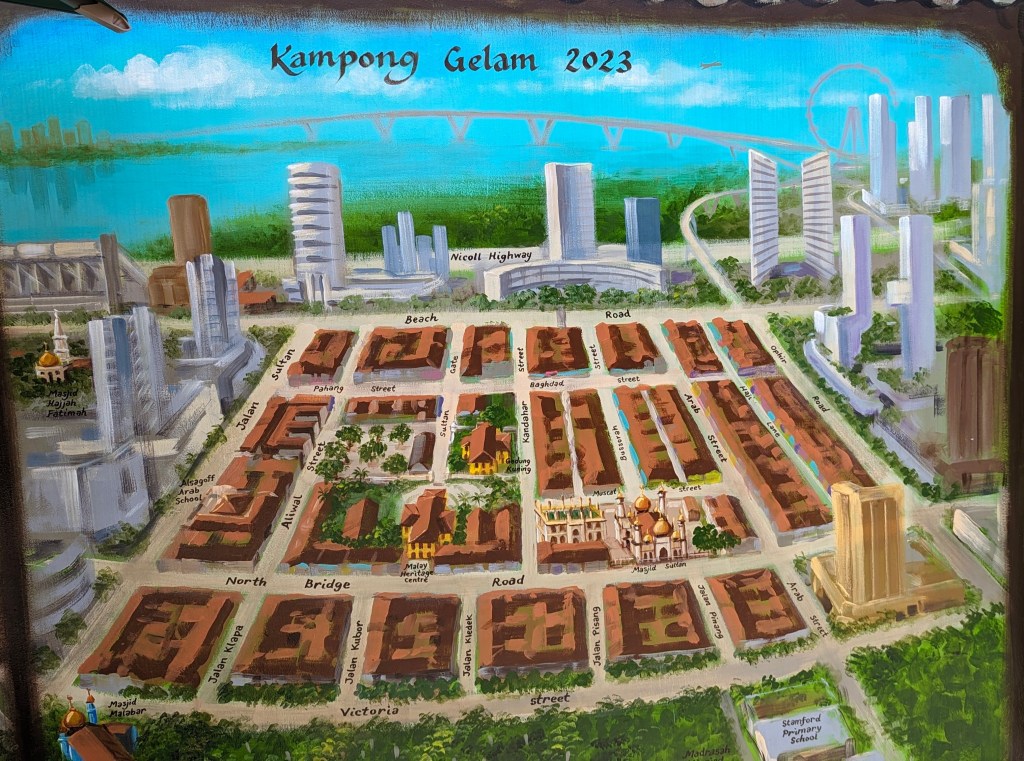
As you walk past the Sultan Mosque crossing the road on Arab Street, it looms out of nowhere looking too big for the street it’s on. The mosque has been around in one form or the other since the 1820s, on Kandahar Street you can see a side by side painted map of the area from the 1920s and 2023 – the Sultan Mosque looked a little different back then but stayed in the same location.
Visitors are welcome to observe for free and there are sarongs and cover-ups provided if you’re wearing shorts, sleeveless tops and your hair (women) is showing.
Singapore has such a varied history with numerous different cultures over it’s many years before independence that it’s no surprise the architecture is an intriguing mix as well. In addition to the interesting architecture, there is also modern street art all over Singapore, usually in theme with the area as well. It’s easy to spend hours wandering the streets and looking around you but we would recommend these areas to begin your self guided walking tour! Murals on Arab St, cute buildings and murals on Haji Lane, beautiful houses and walkways in the Blair Plain conservation area, and Serangoon Road for murals in Little India.
12. Jewel at Changi Airport
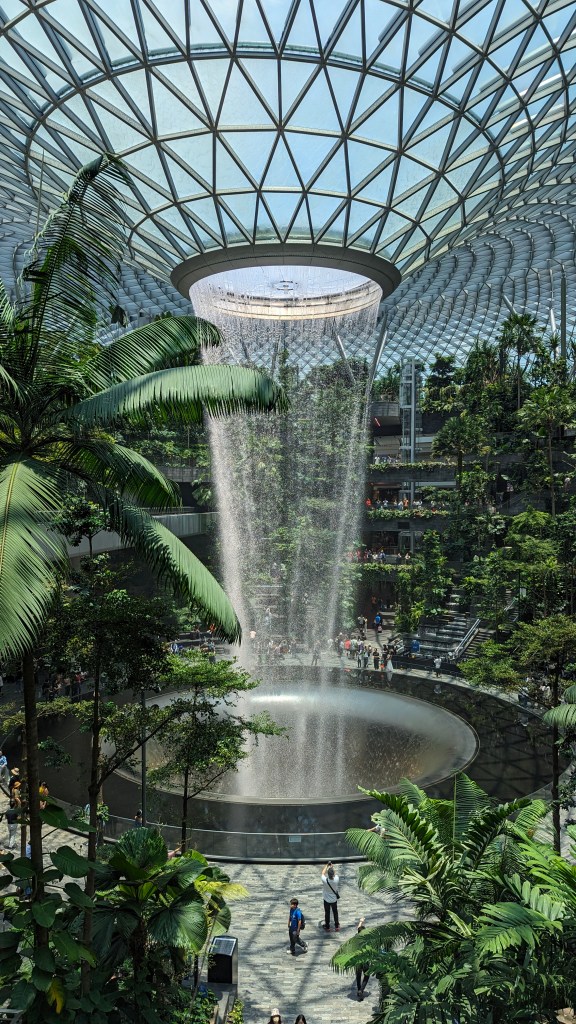
Really, an airport? Yes! This isn’t just any Airport – it’s a Singaporean Airport… and trust us, that makes all the difference!
The Jewel is really a gigantic mall attached to Terminal 1 of Changi Airport. But the thing most people will be there to see is the indoor jungle room, complete with colossal waterfall. It’s easy to get here from whichever terminal you land at, you can either walk or take the free sky train or shuttle bus. Here is a handy ‘how to get there’ guide to help.
Depending on where you’ve flown from and how much energy you have, the best time to see the Jewel is probably when you arrive so you aren’t worried about missing your flight or dealing with desk drop off times. Otherwise we would recommend leaving a good hour to see the Jewel and get to your check in desk, just in case!
Timings: open 24/7 but the shops in the small usually open 10:00am-10:00pm daily
That’s a wrap!
So there you have it, 12 absolutely free things to do in Singapore! Let us know if there’s any we’ve missed or the timings have changed etc. You can get in touch by leaving a comment below or send us a message on Instagram.
This post contains some affiliate links for products that we use extensively on our travels and have decided to partner with. Did you know you can support us, at no additional cost to you, by clicking through and making a purchase using those links? Thank you in advance!
Ayutthaya was the second capital of the Siamese Kingdom, and was founded in 1350. According to the UNESCO description it flourished from the 14th to the 18th centuries, during which time it grew to be one of the world’s largest and most cosmopolitan urban areas and a center of global diplomacy and commerce.
Unfortunately, along came the Burmese and burnt a considerable amount of the old city to the ground, leaving mostly ruins of temples. However, there is enough that remains to understand how impressive the city would have once been and it was well worth a visit. We stayed two nights but you can easily day-trip from Bangkok.
Ayutthaya is located only an hour north of Bangkok making it an easy day trip or stopping off point on travels heading up to Chiang Mai, Chiang Rai and further north. We use 12Go Asia for all our trains, buses, ferries etc. when we can. We’ve included direct links below to the journeys on 12Go, just change the date and you’re all set.
There are a couple of ways to get to Ayutthaya from Bangkok. A very regular train that starts running at 07:10 and finishes at 23:23 will cost about £2.50 and has a journey time between 45-90 minutes depending on the train. Make sure you book a departure station in Bangkok that suits you best, there are a couple of stations the train leaves from. Krung Thep Aphiwat Central Terminal is near Chatuchak, whereas the alternative station is Don Mueang which is a lot further north.
An alternative route is to take a minivan from Mochit New Van Terminal which is close to Chatuchak as well, or Khao San Mama Travel on Khao San Road. Both departure points are easily accessible using a cheap Grab taxi. Of course you can take the metro and trains but these tend to be sometimes slower than hopping on a Grab bike or taking a car depending on the journey. The minivans also run very frequently throughout the day and just leave when they’re full enough, so you’ll need to be slightly flexible on your timings if using these.
Once in Ayutthaya, both the train station and bus station are in the same area. There will be tuk tuks waiting to offer you lifts, don’t forget to negotiate a decent price or just use Grab to make the journey simple! If you haven’t downloaded Grab yet, then we’d absolutely recommend it for travelling around most of SE Asia.
We took a minivan from Mochit New Van Terminal and it left bang on time and got to Ayutthaya even a little ahead of schedule. As we were visiting Ayutthaya on the way to Chiang Mai we didn’t take a return journey to Bangkok, but both the trains and busses run frequently in both directions.
Alongside the central archeological site which contains a lot of ruins, the city has beautiful temples all around the outside. The central temples are easy to cycle around and there cycle paths laid out. If you’re staying in Ayutthaya most hotels and hostels offer free bikes, but if not (or if the quality is poor) then there are plenty of places offering bikes for rent around town.
To visit temples further out, we’d really recommend you rent a moped or hire a tuk tuk for the day! Don’t do what we did… We decided we’d use our hotel’s bikes to cycle to a few temples. We were naïve (borderline psychologically insane) as we thought doing a grand tour via bike would be great. Humidity, 33 degree heat, cycling over dual-carriageway bridges not designed or intended for bikes resulted in one of the sweatiest days of our lives. If you visit Ayutthaya don’t cycle 25km like we did, save that for the inner temples!
Dual carriageway selfie – the drivers and roads were all absolutely fine though, just not designed for cyclists!
Which temples to visit in Ayutthaya
There are so many temples in the center, and on the outskirts, of Ayutthaya. Some now look pretty modern as they’ve been built over ruins to protect them or incorporate them into new temples, others are still ruins as we would expect to see them. Here’s a list of all the temples we saw and would recommend, along with a priority version if you’re pressed for time.
5 must see temples in Ayutthaya
These temples are all within cycling distance of each other, you can walk them too, and are very central, meaning you can easily see them all within a day trip and are nearby enough places to grab a bite to eat to break up the day.
Wat Worachettharam – stunning large complex close to the center
Wat Phra Si Sanphet – another large temple group, close to the center
Wat Phra Ram – very ornate but crumbling complex, close to the center and easily accessible
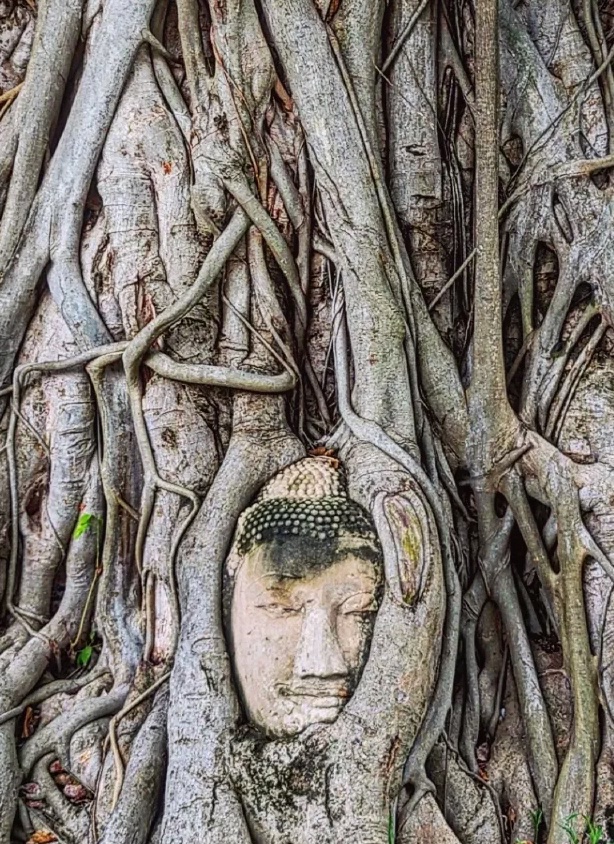
Wat Maha That – probably most famous for the Buddha head in the tree roots. Well worth a visit for lots of other reasons but this is also a beautiful part of the temple demonstrating how nature is slowly taking over
Wat Ratcha Burana – also central, close to the night market and Wat Maha That
6 more temples to see in Ayutthaya
If you have more time in Ayutthaya then we’d recommend adding these into your sightseeing as well. You will need to hire a scooter or take a tuk tuk to these ones though as they’re all outside of the center of town.
Wat Yai Chai Mongkhon – this temple is to the east of Ayutthaya center and has a large reclining buddha that is often draped in gold cloths
Wat Phut Thai Sawan – South of Ayutthaya center, rows of golden buddhas and a starkly white temple complex
Wat Chaiwatthanaram – a large complex on the edge of the river
Wat Suwandararam – interesting temple group with a mix of old ruins and more modern temples, a little south of the center
Wat Phanan Choeng Worawihan – large temple that looks new with a lot of parking infrastructure outside it, inside is an enormous golden Buddha. Near to a Chinese shrine on the river, Chao Mae Soi Dok Mak
Wat Sala Pun Worawihan – small temple group, along the river and west of the center
Keep in mind that as there are 41 temples and more ruins all over the region, this is not an exhaustive list and you may find others to see as well so combine our recommendations with your own research.
Entry fee for Ayutthaya temples
There is no charge to walk around the National Park, which is the area where all the temples are. This means that you can see the temples clearly from the streets around the low-walled complexes for free.
Not all of the temples cost the same, the entry fee prices vary between 20 – 50 Thai Baht.
The entry and exit points on some of the lesser visited temples aren’t very well manned and we accidentally wandered into a couple of temples without realising that you usually have to pay as there was no-one at the entrance to take our money! We found that they’re not very strict on payment for entry unless you turn up with a tour group.
Ayutthaya temples opening times
Most temples open from 8am to 5pm, but keep in mind that there is limited shade at pretty much all of the temples and in the hottest part of the day (11am-2pm) it’s best to take a break for lunch!
This does mean that if you’re doing a day trip from Bangkok to Ayutthaya you will be limited to the number of temples you’ll be able to visit. If you are going to see temples over midday then hats, water and shade-seeking are highly advisable!
Dress code for Ayutthaya
While there is no dress code for the National Park, when you enter the temples you will be asked to dress respectfully, like visiting any other temples in Thailand. That means knees and shoulders covered for both men and women.
Is Ayutthaya worth visiting?
Once you’ve seen one temple you’ve seen them all right? Wrong!! These temples are so different to others you’ll find in Thailand, especially on this scale. For this reason Ayutthaya is definitely worth visiting either from Bangkok as a day trip or on the way up to Chiang Mai.
How long should I stay in Ayutthaya?
If you only visit the 5 must see temples in the centre of town then you can easily make this a day trip from Bangkok.
If you’re keen to see more temples further out then we’d recommend a whole day (with a night stop over) given the closing time, as you might want to have the chance to see more in the morning the next day.
There isn’t much to do in Ayutthaya other than visit the temples so two full days is plenty for visiting Ayutthaya.
Ayutthaya top tips
Walk around the central temples in the evening to see them lit up, they’re absolutely stunning in the daytime and at night.
If you’re staying in Ayutthaya then we’d recommend you pick a central accommodation, we stayed a little out of town and it really added to the journey time to see the temples!
On the whole Ayutthaya is a bit rough and ready, with less infrastructure catered towards tourists compared to other places we’ve visited. Beyond the temples, there isn’t masses to do.
But…there are some fantastic places to eat including:
The night market was full of food and locals and was really interesting to walk through
delicious lunch at Malakor, Ayutthaya – helped break up a hot day!Reclining Buddha at Wat Yai Chai Mongkhon
This post contains affiliate links for 12GoAsia, a transport booking site that we use extensively on our travels. Did you know you can support us, at no additional cost to you, by clicking through and making a purchase using those links?
Medan is a bustling city located in North Sumatra, Indonesia, known for its strategic position as the region’s economic and cultural hub. Situated on the northeastern coast of Sumatra, it boasts a diverse population and a rich history shaped by Dutch colonialism and Malay influences. Medan’s cultural tapestry is vibrant, with a blend of Malay, Batak, Chinese, and Indian traditions, reflected in its cuisine, architecture, and festivals. It feels a little more diverse than Jakarta but very similar in terms of activity and buzz.
Let’s tackle this one straight away! Medan is absolutely worth visiting. It’s a melting pot of cultures which is reflected in it’s people, food, history and attitudes. Indonesian islands are very different to one another despite being part of the same country, and Sumatra is no exception. While this city is not particularly touristy and while we were there we saw very few other tourists, it’s well worth taking a couple of days to explore Medan to get an understanding of the history and culture of this region.
How long to stay in Medan
You are most likely going to be using Medan as a jumping off point for adventure activities such as an Orangutan Trek in Bukit Lawang (the closest airport city to the small region by the jungle) or to head further into North Sumatra. It’s well worth building in some time to experience Medan for itself and not just as a transfer point. One full day in Medan is enough time to see some beautiful parts of the city and learn more about the history of North Sumatra. If you want to take a slower pace then two days would be plenty.
4 must see places in Medan
The list below provides some of the must see things in Medan. We don’t provide a mapped out itinerary because setting out a list like this allows you the flexibility to just pick and choose as you like at your own pace. We’ve set out some suggested timings to help you plan.
State Museum of North Sumatra
This museum is huge and covers so much history of Sumatra from the very early traditions and cultures, through to colonialism (and the end of it), trade and the mix of religious influences on the region. The curation of the exhibitions has been done pretty well and most displays include comprehensive explanations in English. We really enjoyed our visit here and learnt a lot about the island.
Masjid Raya Al-Mashun is an absolutely beautiful mosque that you can enter for a small donation. You’ll need to take your shoes off and dress respectfully (knees and shoulders covered). Women also need to cover their hair but there are shawls on offer for free to cover up.
If your timing is off and you aren’t able to enter due to prayers the outside is still worth admiring. Do check prayer times locally online to make sure you’re not visiting when the Mosque is closed to non-devotees.
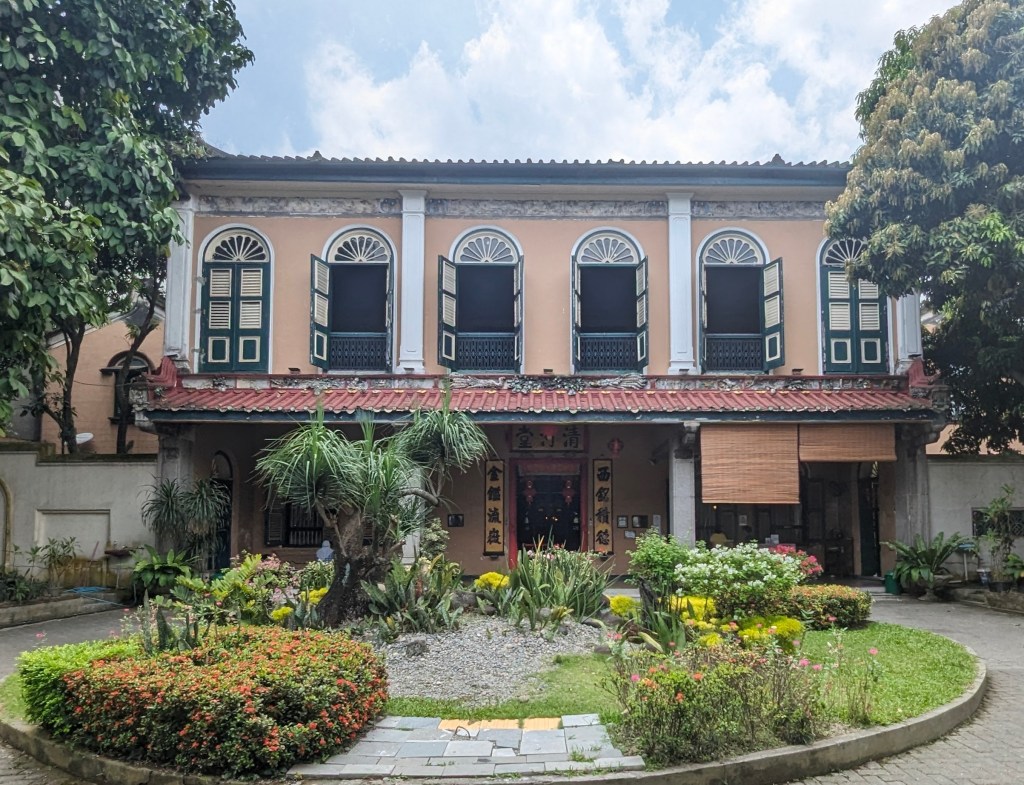
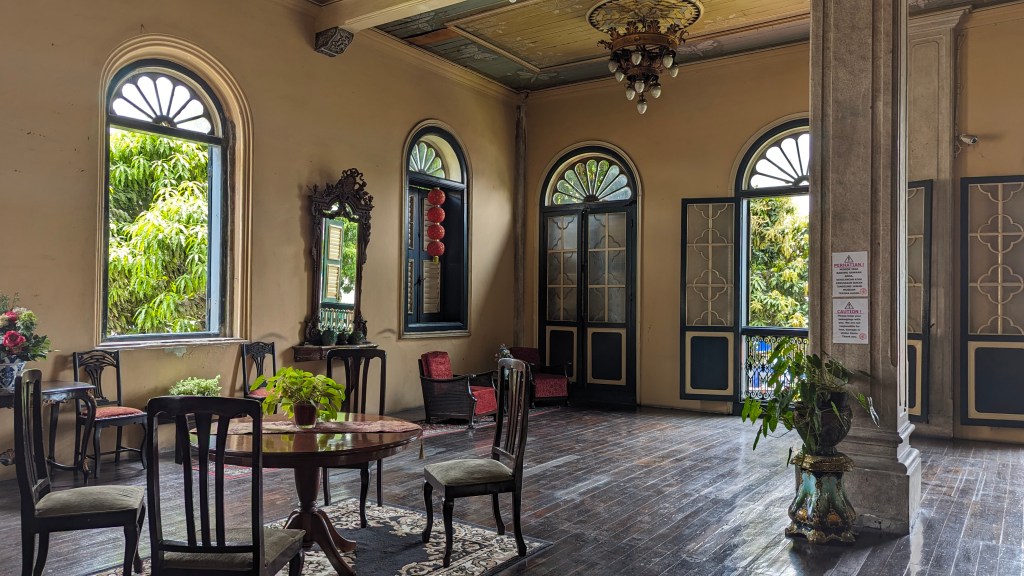
The Tjong A Fie Mansion is the house of a Chinese immigrant who rose to incredible fortune and power in Medan over the late 1800s and early 1900s. His house, made into a museum by a couple of his grandchildren, encapsulates the opulence of his, and his family’s, lifestyle and position in society during a pivotal period in Medan.
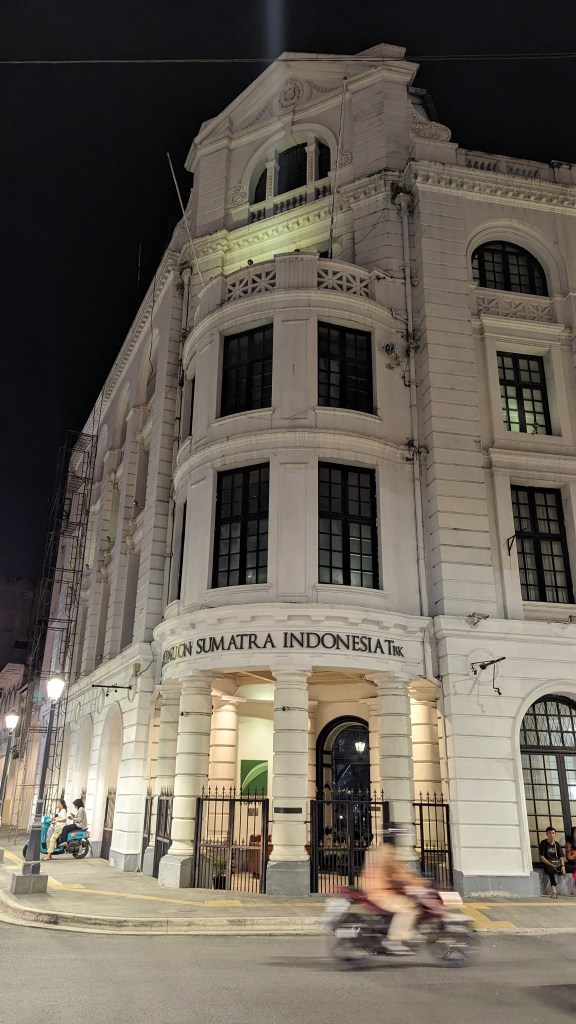
There’s a lot of beautiful architecture in Medan, much of it from the colonial period. This basically means that you can do your own short walking tour just building spotting! Walking down this street in the evening when they’re lit up was one of our favorite things to do in Medan, the buildings just look even more beautiful at night. In total you might want to allow 45 minutes for the route below. Here are the buildings we recommend you stop at:
Pos Bloc Medan – the old post office, built between 1908-1911 by the Dutch, is still in use and is now also a multi-use pop up space! It also has a coffee shop in a beautiful attached building, Common Folk, that is well worth visiting. Make sure you go inside the post office itself to admire the lobby ceiling which is a vibrant work of art on it’s own.
Bank Indonesia Representative Office of Medan – built in 1909 in full ‘traditionalist’ style this is an imposing building just along from the post office. If you’re lucky and ask nicely the security guards at the gate might let you walk past them to take a photo or two!
Old Medan City Hall – now a bit dwarfed by the new city hall building directly behind it, but no less impressive and beautiful. Also built in 1909, it has very similar features to the bank building.
Jl. Balai Kota – this street continues from the Pos Bloc and Bank area (in fact everything in this list is all in the same area) it has some beautiful, but not necessarily landmark worthy, buildings on it and a perfectly lovely way to spend some time is to wander down this street admiring the architecture that is now dotted between newer buildings. Tjong A Fie had his house on this street showing the original prominence of the area.
Avros Cafe – the cafe is in a beautiful old building likely used as a factory or storage space in colonial times. In fact, the name ‘Avros’ belongs to one of the plantation corporations during the colonial period. There is a small museum inside, the opening hours are a bit hit and miss, so fingers crossed you catch it open!
Cafe AvrosPos Bloc MedanThe Kawasan Heritage AreaThe Kawasan Heritage AreaTjong A Fie Mansion
When to visit Medan
The weather in Medan is usually pretty similar throughout the year, hot and humid and ranging from about 25 to 35 degrees Celsius. There are two distinct seasons, wet and dry, with the wet season running from October to March and the dry season from April to September.
We stayed in Medan in March and saw just one proper rainfall during the week we were there. In the peak of the wet season it is very common to have a lot of rain and be quite humid, however there are also fairly high chances of rain throughout the year in Medan!
What to wear in Medan
Medan is in Sumatra which is a predominantly Muslim region. From the 2019 census Medan’s population was made up of about 65% Muslim, 25% Christian, and smaller percentages of other religions such as Buddhist, Taoist, and Hindu religions as well.
This means that generally people wear conservative clothes and women tend to keep their arms and legs covered. When we arrived in Jakarta on Java, which is also a majority Muslim region, Em received some stares while wearing shorts (straight off the plane) and quickly changed into legs and arms being covered which meant far less attention. In Medan, for comparison, it felt a little more relaxed. There’s a greater mix of cultures here than on Java, which made it feel less disrespectful to be uncovered. Em wore long trousers but with strap tops etc. rather than covering up fully.
Please note – any attention we got for wearing different clothes never felt aggressive or unkind, but Em prefers avoiding unnecessary stares if possible and dressing respectfully for the culture of the country / region we are in, so making a small change (though warmer!) was something she was happy to do.
Where to eat in Medan
Medan has a fantastic historical food culture as well as an up and coming new food scene, which really demonstrates how vibrant this city is. Jonny was delighted to learn that Sumatra was the home of rendang, and made it a mission to consume as much as possible. The spice levels of the rendangs changed substantially depending on the restaurant, which was really interesting, but it was always delicious and tender. A few of our favorite places to eat below:
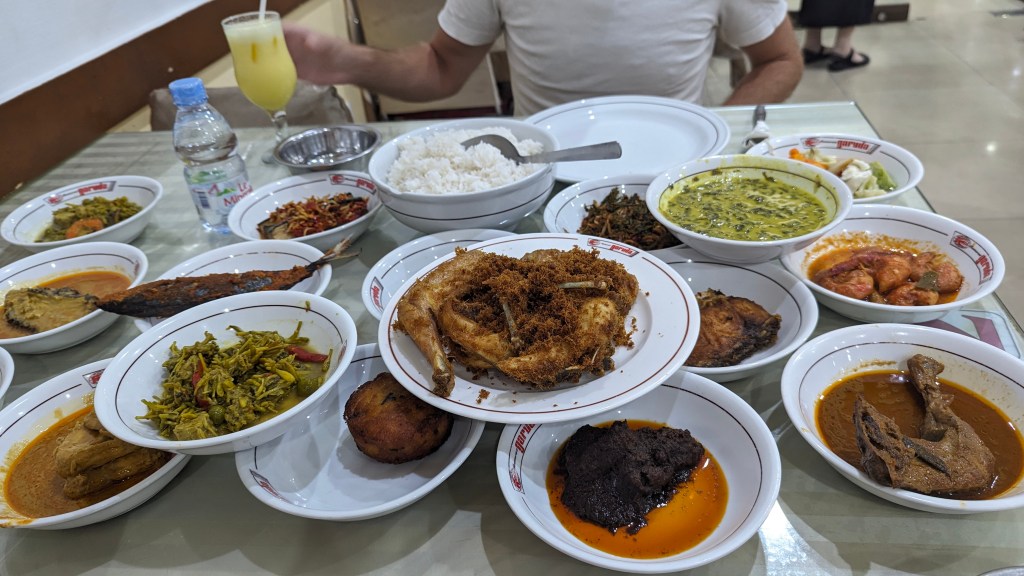
Garuda Restaurant – this is a small chain with a helpful scattering of restaurants in the center of Medan. It offers very standard Medan and North Sumatra local cuisine in comfortable (including AC rooms) restaurants that serve Padang cuisine. Padang food for westerners is a great experience! Lots of different plates of food which you can enjoy together including fish curries, rendang, fried potatoes and steamed vegetables. Some of the dishes are a little spicy but not all. At Garuda, and other similar restaurants, you will be seated and then about twenty dishes will be put on your table. Just eat what you like and pay for that – so don’t panic when multiple dishes are placed in front of you!
Juro Ramen – a new and modern Japanese ramen restaurant with beautifully curated mocktails in a very cool building. The staff are lovely and the food is insanely good. Try the OG Ramen and rice and salmon rice cake as an appetizer (that arancini style unctuousness – they are mind blowing)! This place could be a great option for dinner after an evening walking tour of the Kawasan Heritage Area as it’s in the same location.
El’s Pizzeria – a little outside of town but worth the visit. This small pizzeria serves incredibly good pizzas for South East Asia. To be honest, they’re pretty good full stop (Em promises that isn’t an empty statement having lived in Italy!). The restaurant is basically in someone’s house and the only sign that it’s a restaurant from the outside are the pizza stickers on the window! A bit pricey but the ingredients are legit and the atmosphere very fun.
96 Bakery – this has got to be one of the prettiest and aesthetically pleasing cafes in Medan! The decor is straight out of Pinterest and the brownies are delicious. The cakes also look amazing but we didn’t buy one sadly, a bit too big for us to eat in a day before heading to Singapore! The brownies lasted for three days and still tasted incredible so worth the splurge.
Avros Cafe – this building features twice on this list as it’s located in the Kawasan Heritage Area. The cafe itself is very picturesque and almost art-deco, well worth a coffee stop here.
Padang – local Medan cuisineAmazing brownies from 96 Bakery
How to get around in Medan
Because Medan is so hot during the day walking everywhere isn’t advisable! Grab is such an easy and cheap way to get around, especially if you’re happy to jump on the back of a Grab bike – just make sure they’ve got a helmet for you. We’d really recommend downloading Grab to use across South East Asia as the rates are usually better than local taxis or tuk-tuks
You can also use an Angkot, a little van usually yellow and brightly coloured. These offer very cheap fares and work a bit like a community bus in that drivers will generally be happy to stop along their standard route to pick up or drop you off. Check with each driver where their route is taking them to make sure you’re headed in the right direction. Using these are a fun way of meeting the locals who will generally be happy to help you out as well!
We hope you found this helpful in planning your trip to Medan! We really enjoyed spending a few days here and we’re sure you will too. Don’t forget to subscribe to stay up to date on new posts (if that’s your thing) and follow us on Instagram @jemily_travels to share your travels with us. Happy Travels!
Gili Trawangan, fondly known as Gili T, is the most developed of the three Gili Islands. Gili Meno and Gili Air are certainly not undiscovered, but if you’re after aesthetically pleasing cafes and delicious smoothie bowls for breakfast whilst looking out onto white sands and blue waters, then Gili T is the place for you.
We’re big fans of coffee – those of you following us on Instagram will be used to our cafe hunting endeavors! We tried lots of cafe’s on Gili T and not all of them made the cut – here are five we loved.
Location, location, location!
All these cafes are on the main stretch on the east of the island, which makes them very easy to find as that’s where a lot of the hotels and beautiful beaches are. This side of Gili T is also where the harbour is for boats arriving from Lombok, Bali and the other Gilis, so if you’re waiting to board or have arrived before check-in time at your hotel, these are all perfectly located to kill time in a yummy way!
Just a note on the all important air con: Pretty much all the cafes on Gili T will have air conditioning, but sometimes it’s in a room upstairs or towards the back of the cafe – if you’re after a break from the heat but you don’t get that freezing hit of aircon as you walk through the door, don’t panic, friendly staff can point you in the right direction!
Cafe number 1: Carpe Diem Cafe & Restaurant
This cafe caught our eye as we were walking past thanks to the stunning selection of baked goods on display in the window! The next day we went back for our coffee and pastry pick me up. The team here are so friendly and kind. There were a couple of small kids in that day with their tired parents and the staff were happy to entertain the little ones, carrying them around the cafe and chatting away to them.
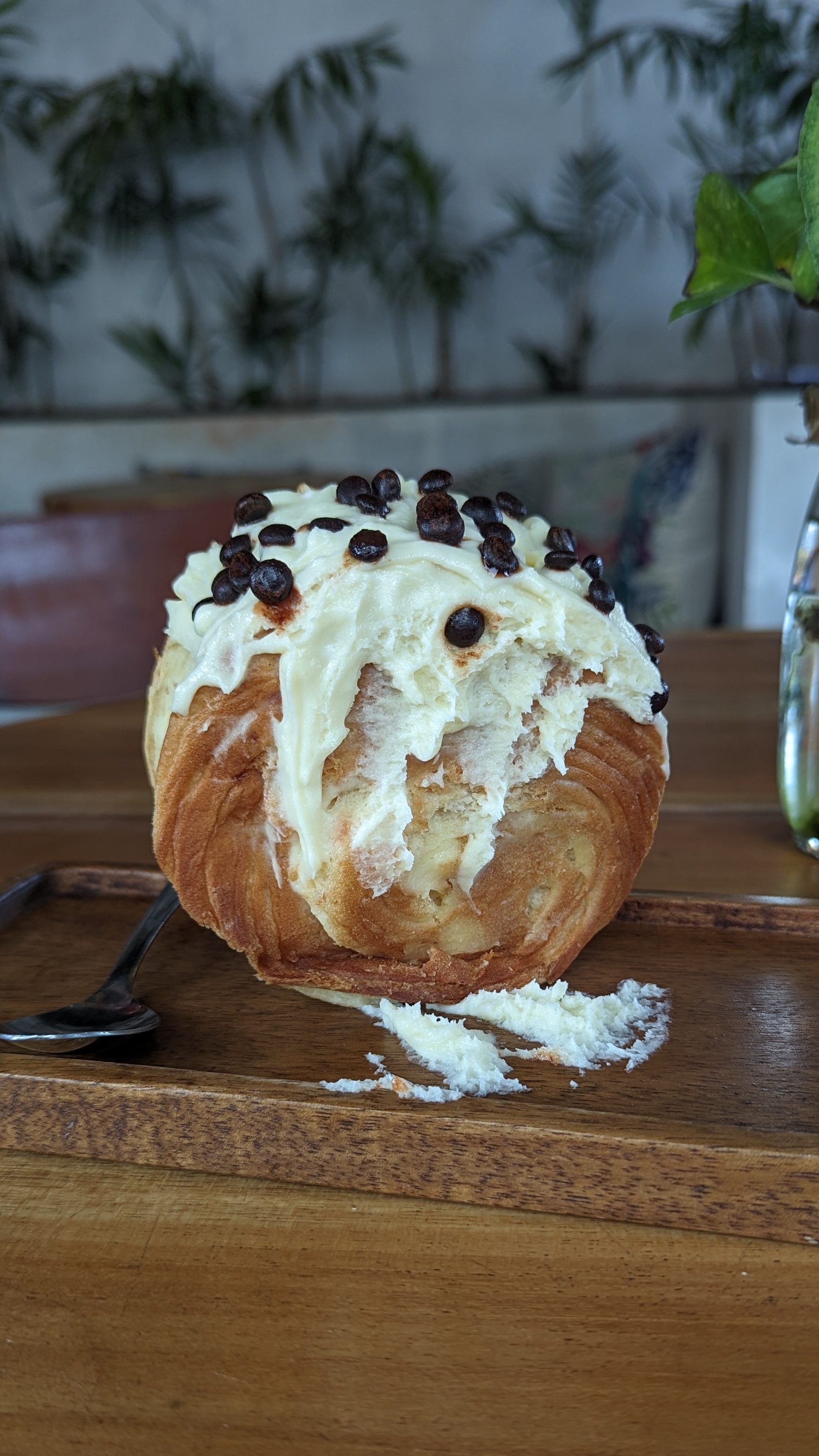
Delicious ‘crombolino’ that fell over but was still tasty!
The cafe itself is decorated beautifully, with large parrot murals and very on trend rope lights. The cafes on GIli T all scream ‘boho beach’ and this is no exception.
We ordered an iced latte, long black and crombolino pastry and were not disappointed. The coffee was great quality and the pastry was delicious! We were half expecting it to be a bit anticlimatic because so many amazing-looking pastries are, especially in South East Asia unfortunately, but this was great!
Carpe Diem is also a restaurant, while we didn’t try their food, it is well rated and the food coming out looked very good. Plus the kitchen staff were super busy, which is always a good sign.
We went here a couple of times for an afternoon coffee because 1) the coffee is great and 2) the atmosphere is so chill.
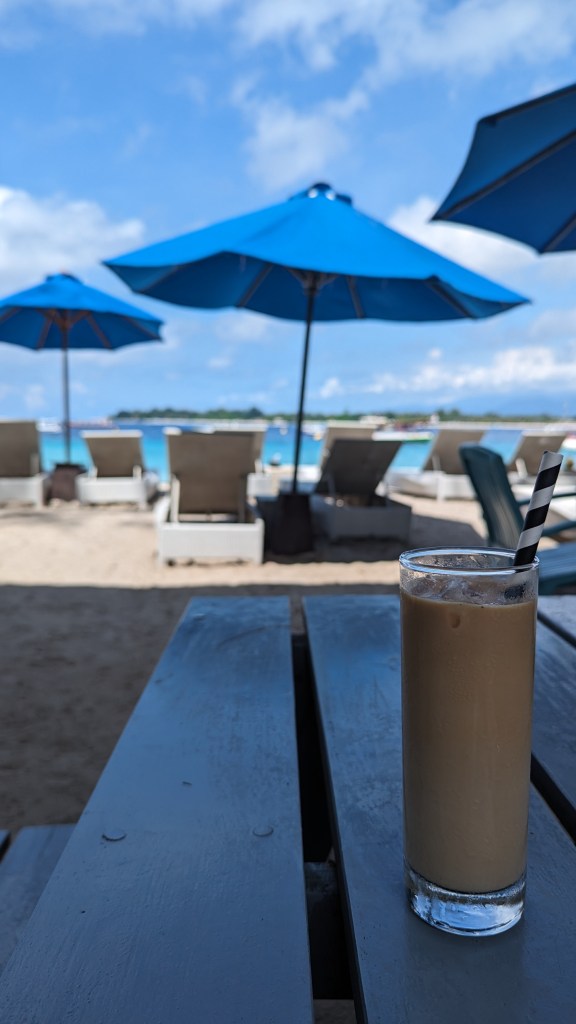
At Taste:Sitting on the sand, drinking a coffee and looking out to the sea – perfect!
Sitting on the beach with the sand between your toes is such a great way to spend an afternoon and the servers are so lovely you don’t feel any stress or pressure to move on. We actually spent about an hour here after finishing our coffees just playing cards and chilling out with no issues.
For people who really like their coffee this was way up there, and (as always) the order was an iced latte and hot long black.
This place does also do food but we didn’t eat here and their food menu looked to be on the pricier side so I would hope the quality is worth it.
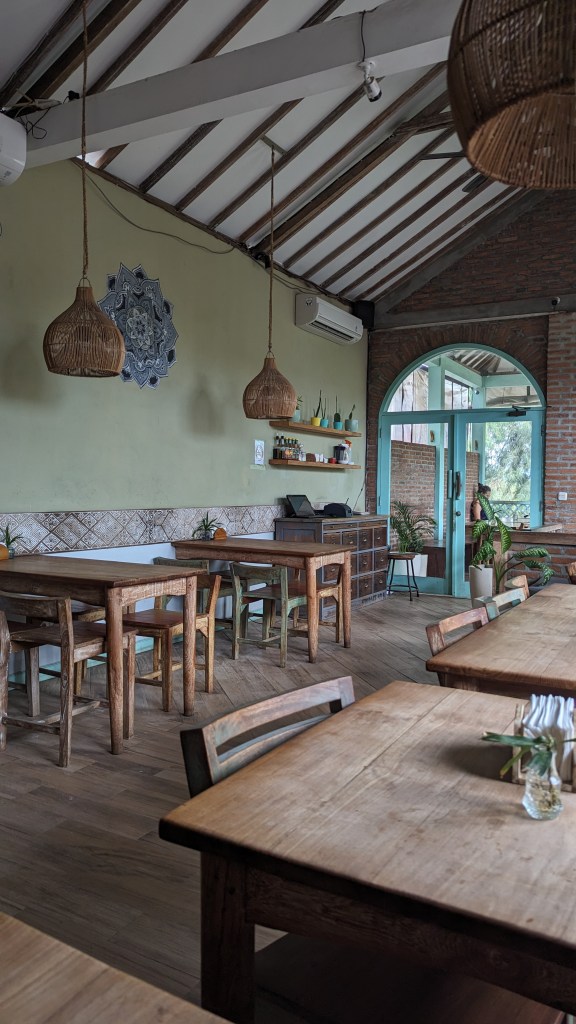
This place looks tiny when you first walk in but it has a large upstairs seating area which is airconditioned and an outdoor balcony overlooking the sea.
It seems to be very popular with digital nomads as somewhere a little bit quieter to get some work done. While it definitely gives off that vibe, it also has some great music playing and friendly waiters who are never short of a smile.
The building is beautiful, with high ceilings and exposed brick work that you’ll notice is very similar to some of the older buildings on the island if you go for a wander through the winding streets.
Beautiful architecture in The Banyan Tree
In addition to the lovely coffee there is a great selection of sweet treats that are mainly vegan along with a large menu that I would have liked to have tried if we were on the island another night (we found Banyan on the last day!).
The cafe also promotes sustainability and eco-friendly initiatives, which is especially important on such a small island that relies on shipping it’s produce in from nearby Lombok and Bali.
This cafe is such a vibe, it’s constantly bustling as it’s right by the harbour and serves great coffee, cakes, smoothie bowls and avocado toast.
Absolutely amazing smoothie bowl from Coco Cafe & Ice Cream
We popped in here on our first morning for a pick me up brunch and it totally hit the spot. The music is great, the staff are chaotic but lovely, and everything tastes delicious. It’s pretty small though so find a table and hold it for dear life! It’s worth it.
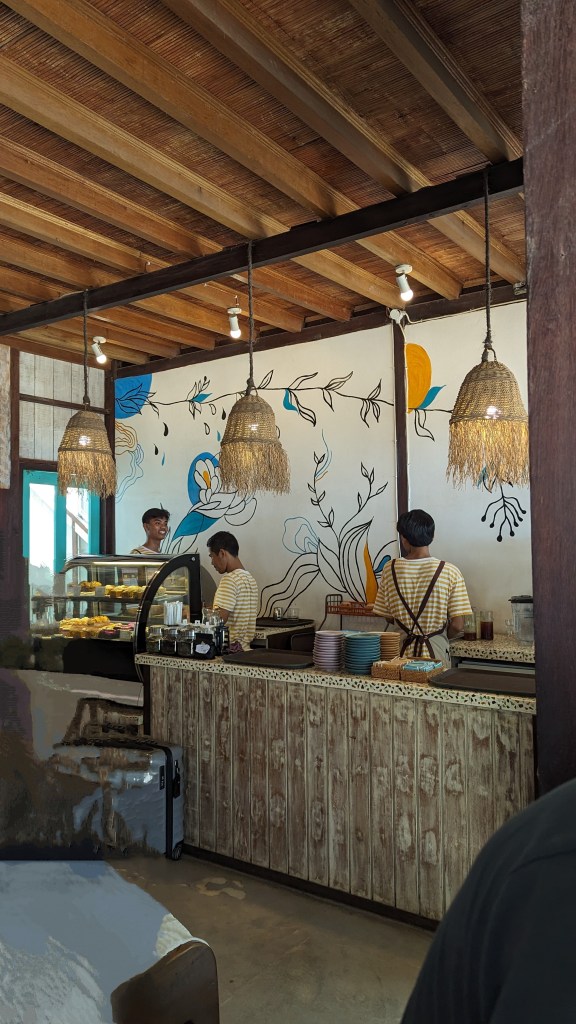
The first thing you’ll notice about this cute cafe is the servers’ outfits! They’re something between a Venetian gondolier and bumble bees! The team are lovely, busy and never far away.
The art in this cafe is beautiful, I loved the design wall behind the counter – it’s so fun and boho I had to sneak a picture.
Gorgeous art work at Coffee & Thyme!
The coffee here is a great but so are the cakes and pastries – pop in for a quick coffee, stay for a slice of cake and recharge. If you can snag the little booth in the window this place is also the best cafe for people watching. We ended up staying here for ages watching life on Gili T go by.
And there we have it, five of the cutest cafes in Gili Trawangan for you to get your coffee fix. Most of the cafes on Gili T cater for more than just coffee and tea so if you’re after brunch, or cake, or somewhere to set up your laptop for a few hours and get some work done – these will definitely serve your needs.
We’d love to hear if you’ve tried any of these and if you have any others to add to the list. Leave a comment so we can see!











 Our Travel Planning